7 best RFP Software to save time and win more deals in 2026
.png)
.png)
Introduction
The Request for Proposal (RFP) response process has undergone a dramatic transformation in 2026, with automation emerging as the key factor for success. Organizations that once spent weeks manually crafting proposals now rely heavily on advanced AI-powered platforms to automate the entire RFP process, dramatically increasing response speed and accuracy. Today’s leading RFP software stands out by offering advanced AI features and serving as a centralized AI platform, enabling sales and proposal teams to work more efficiently and collaboratively. As competition intensifies and deadlines tighten, choosing a toolwith robust automation capabilities and response automation has become the most critical strategic decision for proposal managers and revenue teams.
Research shows that teams using modern automated RFP software experience significant productivity gains, with some solutions automating up to 90% of the response workflow. These platforms combine AI-powered response generation, content management, workflow automation, and strategic insights to streamline proposal creation, improve response quality, and enable organizations to pursue more opportunities without expanding headcount or working longer hours.
In this comprehensive guide, we examine the top 7 RFP software solutions for 2026, analyzing their key features, pricing structures, ideal use cases, and competitive advantages. Whether you’re a startup managing your first RFPs or an enterprise handling hundreds of complex proposals annually, this comparison will help you identify the platform that best aligns with your needs.
For further insights on AI-driven sales automation, see the Gartner report on AI in sales.
To understand security compliance requirements, refer to the ISO/IEC 27001 standard and SOC 2 compliance guidelines.
Quick Comparison Table
Compare leading RFP software solutions to see how they help you manage proposals and choose the right pricing plan for your team's needs.
1. Steerlab – Best RFP Software for 2026

Rating: ⭐ 5/5
Steerlab stands out as the best overall RFP software for B2B SaaS teams, offering a robust platform that automates responses to RFPs, RFIs, and security questionnaires. Its AI-driven features streamline proposal creation, enhance writing quality, and provide actionable win insights, making it a top choice for PreSales, Proposal, and Security teams.
Founded in 2023 and based in Paris, Steerlab has quickly become a strategic response management platform, helping organizations optimize their response processes and scale efficiently across the US and Europe. Try for free or book a demo to see how Steerlab can transform your RFP workflow.
Key Features
Advanced AI Automation: Steerlab leverages automated workflows to streamline the proposal process, automatically generating 80%+ of your RFP document in minutes with factual, sourced, ai generated answers that are free from hallucinations. The platform supports both structured Q&A formats and complex narrative RFPs, including executive summaries, solution descriptions, and security appendices. RFP 'Shredding' uses AI to deconstruct lengthy documents into structured requirements and compliance matrices.
Smart Content Library: Gone are the days of manually maintaining outdated content libraries. Steerlab provides instant access to AI-powered content suggestions and a centralized library, allowing users to quickly retrieve the information they need. The system auto-classifies content by product, topic, use case, and persona, automatically translates responses across 100+ languages, and continuously maintains and cleans outdated entries based on usage patterns. Smart Content Reuse automatically identifies the most relevant previous answers and flags stale content for update. Knowledge Graphs connect directly to your tech stack in real-time, eliminating the need for manual library maintenance. The system builds a single source of truth that stays fresh without manual effort.
Strategic Intelligence: Beyond automation, Steerlab delivers actionable business intelligence that helps teams focus on the right opportunities:
- Go/No-Go Agent: Evaluates whether to respond based on fit, likelihood of winning, and internal capacity
- Bias Detection Agent: Spots red flags like competitor-written questions or skewed scoring criteria
- Gap Analysis: Highlights missing content, features, or capabilities that could impact your proposal
- Data-Backed Win Probability: Provides objective metrics to guide strategic decisions
Seamless Collaboration: The platform offers robust project management with progress tracking, task assignment, inline commenting, and collaborative editing. Teams can seamlessly contribute and coordinate within a unified workspace.
Meeting Users Where They Are: Steerlab integrates directly into your existing workflow through:
- Chrome extension for web-based questionnaires
- Slack bot for real-time notifications
- AI Co-Pilot for in-context assistance
- Built-in connectors to Google Drive, SharePoint, Salesforce, HubSpot, Confluence, Notion, and more
Enterprise-Grade Security: Built to the highest security standards with SOC2 and ISO27001 compliance, Steerlab ensures your company’s sensitive data remains protected. The platform includes SSO integration with Okta, Auth0, and Azure AD.
Pricing
Steerlab offers a custom pricing plan based on team size and usage volume. The platform includes unlimited users, full AI capabilities, and all integrations without hidden fees. Contact their sales team for a personalized quote. First RFP or questionnaire is free to try.
Ideal For
- B2B SaaS companies managing high volumes of RFPs and security questionnaires, looking to streamline the entire process from request creation to final submission
- PreSales and proposal teams seeking maximum automation without sacrificing quality
- Organizations requiring multilingual proposal capabilities
- Security teams handling vendor assessment questionnaires
- Companies prioritizing strategic win probability insights over basic content management
✅ Pros
- Industry-leading 90%+ automation rate
- Human-quality AI responses with proper citations
- Self-maintaining content library reduces admin burden
- Strategic intelligence tools (Go/No-Go, bias detection)
- Excellent integration ecosystem
- Chrome extension and Slack bot for workflow efficiency
- Multilingual support (100+ languages)
- High user satisfaction ratings
- Strong visual presentation for professional, branded proposals
❌ Cons
- Custom pricing may not suit very small teams
- Relatively new player (founded 2023), though rapidly gaining traction
- Best suited for B2B SaaS; other industries may need customization
Bottom Line
Steerlab represents the cutting edge of RFP automation technology in 2026. Its combination of advanced AI, strategic intelligence, and exceptional user experience makes it the top choice for ambitious teams who want to win more deals while spending less time on repetitive tasks. The platform’s ability to automate 90%+ of responses while delivering human-quality output positions it as the market leader for forward-thinking organizations focused on submitting winning proposals.
2. Loopio – Best for Mid-Market Team

Rating: ⭐ 4.6/5
Loopio has been a mainstay in the RFP software market for years and continues to deliver solid value for mid-market organizations. Based in Toronto, Loopio specializes in helping companies accelerate and enhance responses to RFPs, DDQs, and security questionnaires.
Key Features
Centralized Content Library: Loopio stores all company content in one organized location with categorization for easy access. The platform’s search functionality helps teams quickly locate relevant information.
Team Collaboration & Real-Time Co-Editing: Loopio emphasizes team collaboration by enabling seamless communication, task assignment, and consolidated content management. Real-Time Co-Editing supports simultaneous multi-user editing with in-app commenting and version control, allowing teams to work together efficiently on RFP responses.
Magic Recommendations: Loopio’s signature feature automatically matches RFP questions with content from your library. The AI suggests responses that you can accept, edit, or assign to subject matter experts for review.
Project Management Dashboard: Teams get full visibility into ongoing RFPs with real-time tracking of task status, workload distribution, and project completion metrics.
Loopio AI Writing Assistant: Introduced in 2026, this feature helps improve or rephrase answers and ensures consistency in tone across responses. The AI also identifies duplicate content in your library and prompts consolidation.
Pricing
Starting around $1,000+ per month depending on team size and features. Loopio uses a per-user pricing model with different tiers offering varying levels of AI capabilities and automation.
Ideal For
Mid-market companies with established RFP volumes, teams prioritizing ease of use, and organizations seeking a well-established platform with strong customer support.
✅ Pros
- User-friendly interface with minimal learning curve
- Strong customer support team
- Established market presence with proven track record
- Good project management capabilities
- Regular feature updates and improvements
- Ability to create professional looking proposals
❌ Cons
- AI automation less advanced than newer competitors
- Content library requires more manual maintenance
- Higher per-user costs can add up for larger teams
- Limited strategic intelligence features
3. Responsive – Best for Enterprise Organizations
Rating: ⭐ 4.5/5
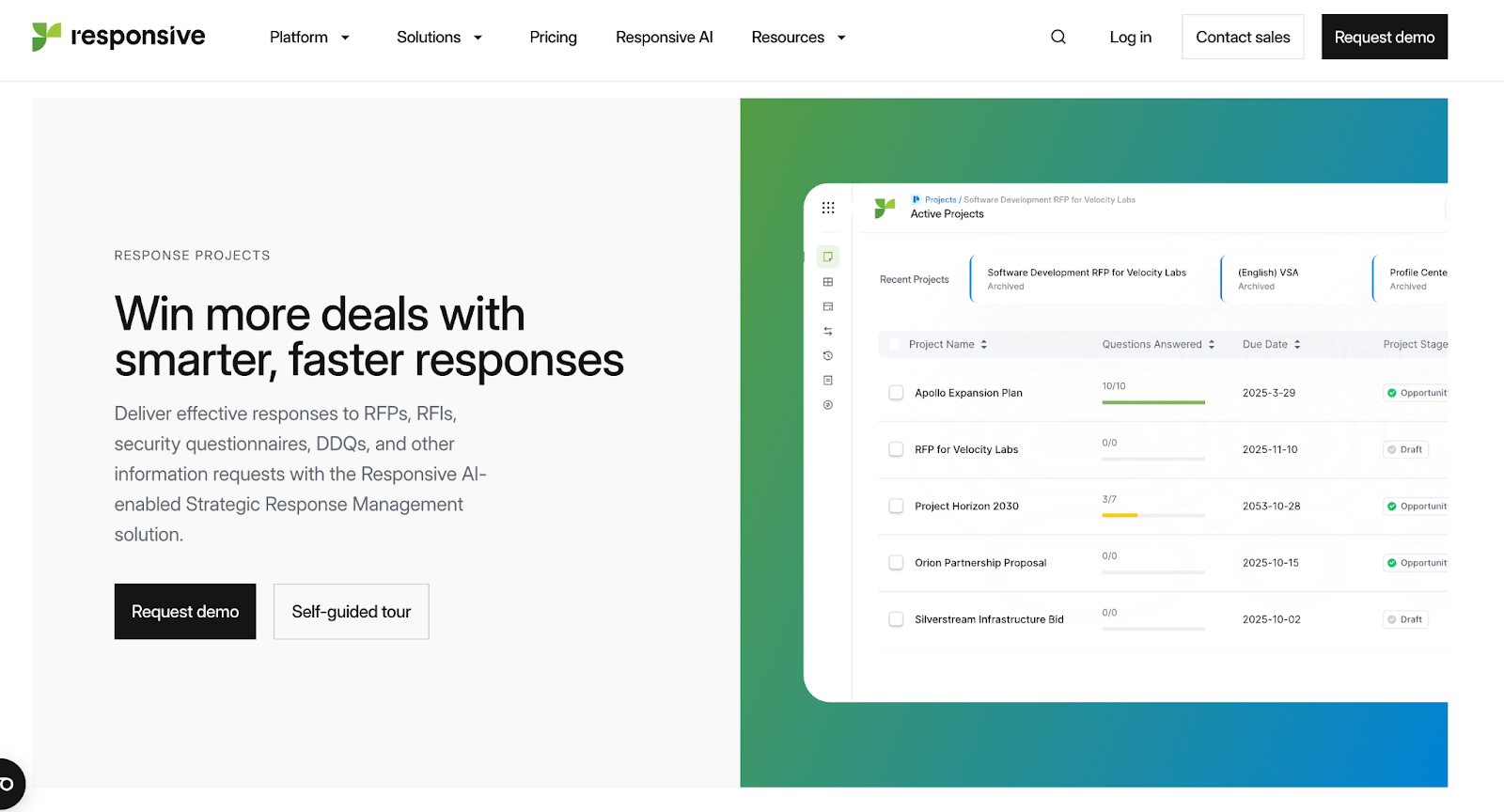
Formerly known as RFPIO, Responsive has evolved into a comprehensive enterprise RFP management platform with a global reach. The solution is designed for large organizations managing complex, high-volume proposal operations.
Key Features
Automatic Import: Responsive uses patented import technology to upload Word, Excel, and PDF RFPs, automatically detecting and mapping every section and requirement.
Extensive Integration Network: With 20+ native integrations and 75+ API connections, Responsive integrates smoothly with complex enterprise tech environments.
Requirement Analysis: The AI reviews documents, highlights key requirements, and analyzes how well projects fit your strategic goals to streamline bid/no-bid decisions.
Robust Analytics: Ten built-in report templates help teams uncover trends, measure efficiency, and identify process bottlenecks. Responsive's analytics features provide detailed analysis of past bids and proposal performance, informing future strategies. Advanced Analytics includes dashboards tracking win rates and response times to identify strategic improvements.
Pricing
Custom enterprise pricing based on organization size and requirements. Responsive targets larger organizations with substantial RFP volumes.
Ideal For
Large enterprises with complex workflows, organizations requiring extensive integrations, and companies prioritizing comprehensive analytics and reporting.
✅ Pros
- Powerful integration capabilities
- Strong analytics and reporting
- Proven enterprise scalability
- Comprehensive feature set
❌ Cons
- Can be overwhelming for smaller teams
- Implementation requires significant time investment
- Higher price point
- Steeper learning curve than competitors
4. Qvidian – Best for Marketing-Driven Teams
Rating: ⭐4.3/5
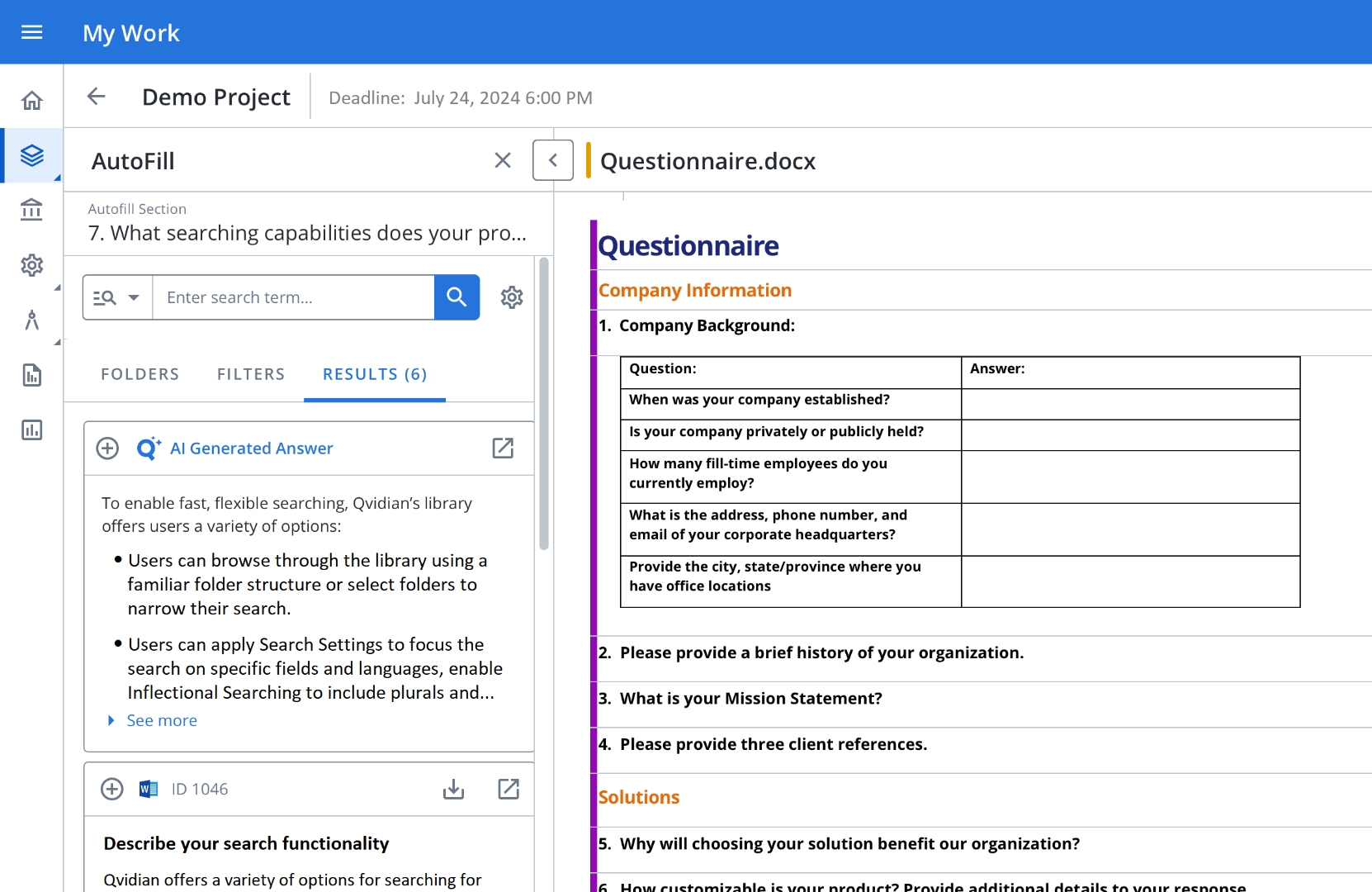
Part of the Upland Software family, Qvidian is a legacy RFP platform that has added AI capabilities to stay competitive. It's particularly strong for teams that prioritize content governance and brand consistency.
Key Features
Extensive Content Library: Custom folder structures, metadata fields, and tagging systems make content highly organized and searchable.
AI Assist: Generative AI drafts responses and rewrites existing content using the library. Teams can set custom rules for tone and language to maintain brand voice.
Collaboration Tools: Real-time collaboration features and automated workflows enable seamless team coordination and enhance productivity and accuracy in proposal development.
Qvidian Analytics: Over 70 dashboards provide insights about content library usage, RFP process efficiency, and team productivity.
Integration Capabilities: Many RFP software solutions, including Qvidian, provide integration capabilities with existing CRM systems to streamline the proposal process.
Marketing Focus: Strong emphasis on brand consistency and marketing material integration makes it popular with marketing-driven proposal teams.
Pricing
Custom enterprise pricing. Qvidian targets mid-to-large organizations with established proposal processes.
Ideal For
Marketing-driven proposal teams, organizations prioritizing security and compliance, and companies requiring extensive reporting capabilities.
✅ Pros
- 25+ years of market experience
- Strong security features
- Comprehensive analytics (70+ dashboards)
- Good for brand consistency
- Integrated contract management capabilities for streamlined proposal and deal-closing processes
❌ Cons
Clunky interface with workflow issues
Rated lower for ease of use (8th on G2)
AI capabilities lag behind newer competitors
Frequent bug reports from users can often be addressed by optimizing your RFP process with management proposal software to improve efficiency and accuracy.
5. DeepRFP – Best for Government Proposal

Rating: ⭐ 3.6/5
DeepRFP was built AI-first before the ChatGPT era and has evolved into a sophisticated platform designed specifically for proposal professionals. The platform offers autonomous AI agents for every stage of the proposal process.
Key Features
AI Agent Ecosystem: DeepRFP deploys specialized agents for different proposal tasks, supporting strategic response management across the entire RFP process:
- Proposal Writer: Drafts complete proposals in minutes
- RFP Analyzer: Supports bid/no-bid decisions
- Questionnaire Responder: Auto-fills forms and questionnaires
- Proposal Reviewer: Analyzes drafts for compliance and quality
Automated Workflows: Break down large RFPs into actionable tasks, automatically assigning questions to subject matter experts with automated reminders to ensure timely and accurate responses.
Compliance-Focused: Strong emphasis on compliance checking and requirement tracking throughout the proposal lifecycle.
Color Reviews: Built-in tools for conducting pink, red, and gold team reviews on draft proposals.
Technical Expertise: Virtual technical experts help answer complex product or solution questions and can guide you through seamless integrations with Steerlab to streamline your workflow.
Pricing
Starting at $399 per month with transparent pricing tiers published on their website.
Ideal For
Experienced proposal professionals, government contractors, and organizations managing complex, compliance-heavy bids.
✅ Pros
- Comprehensive AI agent suite
- Built for AI from day one
- Strong compliance features
- Excellent for complex proposals
- Vendor management capabilities for streamlined SaaS sourcing and procurement
- Transparent pricing
❌ Cons
- Interface can be overwhelming for beginners
- Fewer collaboration features
- Limited integrations compared to market leaders
- Best suited for experienced users who require enterprise-grade security
6. Ombud – Good for Entreprise Revops

Rating: ⭐ 4.7/5
Ombud is a revenue productivity and knowledge management platform built to help enterprise sales, proposal, and customer-facing teams respond to RFPs, RFIs, security questionnaires, and client documentation faster using AI-driven knowledge orchestration. The platform focuses on unifying institutional knowledge, automating response workflows, and improving cross-team collaboration.
Key Features
AI-Powered Knowledge Engine: Ombud uses AI and machine learning to centralize and surface the most relevant, approved content across departments, enabling teams to generate accurate and consistent responses quickly:
Smart Content Recommendations: Automatically suggests relevant answers and supporting documents
AI Search & Knowledge Graph: Connects content, experts, and historical responses across systems
Automated Response Generation: Uses generative AI to draft responses based on approved knowledge assets
Expertise Identification: Recommends subject matter experts for complex questions
Pricing
Custom enterprise pricing based on organization size, users, and implementation requirements.
Ideal For
Enterprise sales teams, RevOps organizations, proposal management teams, and companies managing high volumes of RFPs, security questionnaires, and customer-facing documentation.
✅ Pros
- Strong enterprise knowledge management capabilities
- Advanced AI-driven content recommendations
- Excellent collaboration across departments
- Robust analytics and reporting tools
- Wide range of enterprise integrations
- Strong governance and compliance controls
❌ Cons
- Custom pricing lacks transparency
- Implementation can require significant onboarding effort
- May be overly complex for small teams
- AI automation is strong but less agent-based compared to newer AI-native competitors
7. AutogenAI – Good for SMB
Rating: ⭐ 4.4/5
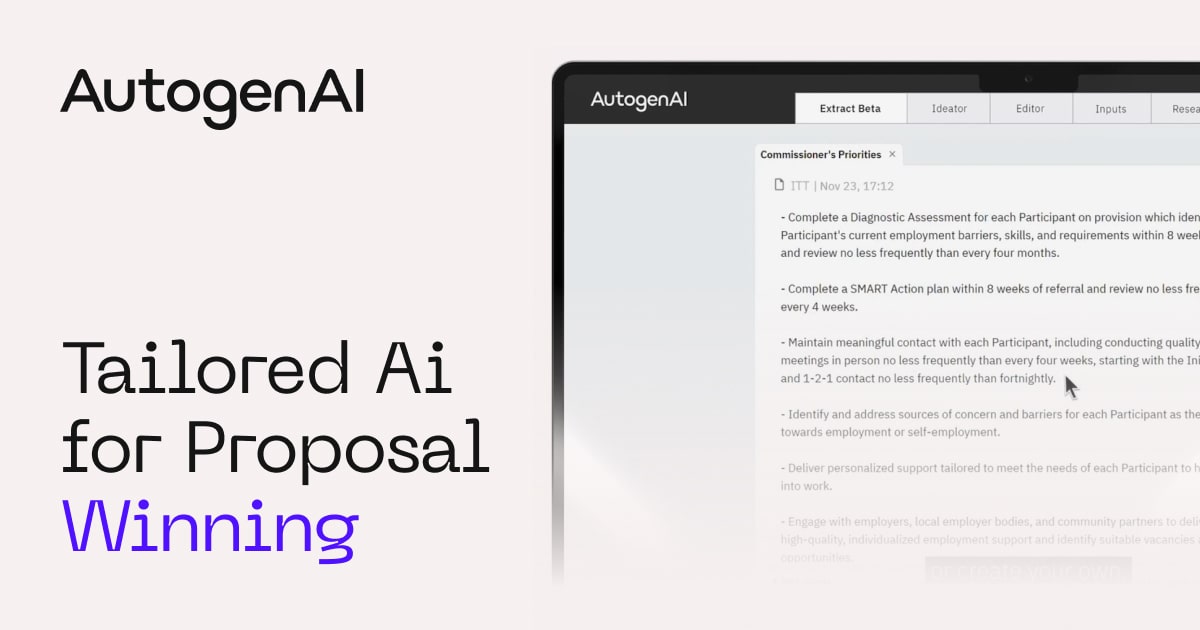
AutogenAI is an AI-first proposal writing and management platform designed to help organizations rapidly create high-quality, compliant proposals and manage the full RFP lifecycle. The platform integrates generative AI with project and content management capabilities, enabling teams to produce winning proposals significantly faster while improving overall bid success rates.
Key Features
AI-Driven Proposal Writing: AutogenAI uses advanced generative AI to transform requirements into high-quality proposal drafts in just a few steps, helping teams accelerate drafting speed and improve productivity.
Custom Language Engines: The platform builds bespoke language models tailored to each organization’s tone, technical knowledge, and brand voice, enabling highly personalized and consistent proposal content.
Opportunity Qualification and Extraction: Automatically extracts key requirements, deadlines, and evaluation criteria from RFP documents, helping teams make informed bid/no-bid decisions and stay aligned with submission requirements.
End-to-End Proposal Management: Combines AI writing with project management functionality to help teams manage opportunity tracking, content libraries, research, drafting, and review workflows within one unified platform.
Collaborative Review and Content Reuse: Enables teams to leverage previous responses, centralized knowledge repositories, and document comparison tools to ensure consistency, accuracy, and efficiency across proposals.
Pricing
AutogenAI operates on a custom enterprise pricing model with no publicly listed pricing. Industry estimates suggest pricing typically starts around $30,000+ annually with minimum seat requirements, and final costs depend on organizational scale, modules, and implementation needs.
Ideal For
SMB proposals teams.
✅ Pros
- Advanced AI-first proposal drafting capabilities
- Custom language engines tailored to organizational voice
- Strong productivity and drafting speed improvements
- Integrated project and proposal management features
- High-touch onboarding and customer success support
❌ Cons
- Limited AI capabilities
- Primarily targeted toward SMB users
- Limited native integrations compared to some competitors
- Interface may require onboarding and training for new users
How to Choose the Right RFP Software for Your Team
Selecting the optimal RFP software requires careful consideration of your organization’s specific needs, resources, and growth trajectory. RFP software helps organizations stay organized by keeping all relevant information about vendor proposals in one place. The ability to import and export data easily is an essential feature of RFP software, ensuring seamless workflows and data portability. Additionally, RFP software centralizes content in a single library, allowing teams to respond with up-to-date and accurate information.
Here are the key factors to evaluate:
Security and Compliance: Prioritize solutions that emphasize data security and the protection of customer data. Look for vendors with robust security certifications (such as SOC2) and clear privacy standards, ensuring that customer data is never used for training AI models. A dedicated InfoSec team and strong compliance measures are critical to prevent data leakage and maintain trust.
Integration Requirements: Assess how well the RFP software integrates with your existing tools and data sources, such as Google Drive, SharePoint, Confluence, and Notion. Seamless integration with these repositories enables you to import, synchronize, and leverage relevant information for accurate and efficient proposal responses.
1. Team Size and Structure
Small teams benefit from simple, affordable solutions like AutogenAI that don't require extensive setup. Mid-market and entreprise teams should consider platforms like Loopio or Steerlab that balance automation with collaboration.
2. RFP Volume and Complexity
If you handle fewer than 40 RFPs annually, a basic tool may suffice. For more than 40 RFPs per year, invest in platforms with strong AI automation like Steerlab to maximize efficiency.
3. AI Automation Priority
Teams seeking maximum automation should prioritize platforms with 85%+ automation rates like Steerlab or DeepRFP. If you prefer human oversight with AI assistance, Loopio or Qvidian provide good balance. Consider how much time you're currently spending on manual tasks and calculate potential time savings.
4. Integration Requirements
Evaluate your existing tech stack and ensure your chosen platform integrates seamlessly. Steerlab and Responsive offer the most extensive integration ecosystems (20+ native connectors), making them ideal for complex environments. Smaller teams with simpler stacks can succeed with platforms offering 10-15 core integrations.
5. Budget Constraints
Startup budgets typically start at $299+/month. Mid-market organizations should budget $1,000-3,000 monthly for solutions like Loopio. Enterprise organizations can expect $3,000-10,000+ monthly for comprehensive platforms with full feature sets and dedicated support. However, Steerlab offers flexible, variable pricing designed to accommodate organizations of all sizes and budgets. Whether you're a startup, a mid-market team, or a large enterprise, Steerlab can tailor its pricing and features to meet your specific needs, making it the ideal all-in-one solution to transform your entire RFP response process.
6. Security and Compliance
Organizations in regulated industries or handling sensitive data must prioritize SOC2, ISO27001, and industry-specific compliance. Steerlab, Loopio and Responsive all offer enterprise-grade security. Government contractors should evaluate platforms like DeepRFP with specific compliance tools.
7. Industry-Specific Needs
B2B SaaS companies benefit most from Steerlab's industry-specific features and multilingual support. Government contractors should consider DeepRFP or platforms with compliance focus. Professional services firms may prefer Loopio's project management capabilities.
The Future of the RFP Software Market: Trends for 2026 and Beyond
The RFP software landscape continues to evolve rapidly, driven by advances in artificial intelligence and changing buyer expectations. Modern solutions are increasingly positioned as comprehensive ai platforms, offering advanced ai features such as generative AI, automated response drafting, and intelligent content management. These capabilities are designed to improve efficiency, collaboration, and win rates for sales and PreSales teams.
Several key trends are shaping the future of proposal automation. Generative Drafting in modern RFP software now automatically generates 80-95% accurate first drafts by analyzing historical wins, significantly reducing manual effort and accelerating response times.
Looking ahead, the industry is moving toward the adoption of strategic response management platforms. These platforms combine business intelligence, process efficiency, and tailored editions to optimize strategic response processes for organizations of all sizes.
Agentic AI Systems
The shift from simple content matching to autonomous AI agents represents the biggest transformation in RFP software. Platforms like Steerlab and DeepRFP deploy specialized agents that handle specific proposal tasks—from analyzing requirements to detecting bias to generating compliant responses. These agents work collaboratively, much like a human proposal team, but operate at machine speed.
Strategic Intelligence Integration
Modern RFP software has evolved beyond efficiency tools into strategic decision-making platforms. Win probability scoring, competitor analysis, and bid/no-bid recommendations help teams focus resources on the most promising opportunities. Steerlab's strategic intelligence features exemplify this trend, providing data-backed insights that directly impact win rates.
Multi-Modal Content Processing
The ability to handle diverse content types—from technical specifications to marketing materials to video demonstrations—is becoming standard. AI systems that can understand and generate multiple content formats enable richer, more compelling proposals that resonate with evaluators.
Continuous Learning Systems
Self-improving platforms that learn from each proposal submission represent the next frontier. These systems automatically identify which content performs best, update libraries based on win/loss patterns, and adapt messaging to changing market conditions without manual intervention.
Real-Time Collaboration
As remote and distributed teams become the norm, RFP platforms increasingly emphasize real-time collaboration features and robust collaboration tools. Slack integrations, Chrome extensions, and in-context commenting allow team members to contribute efficiently regardless of location or time zone.
Conclusion
The RFP software market in 2026 offers powerful solutions for every organization size and use case. While all seven platforms examined in this guide deliver value, Steerlab stands out as the top choice for teams seeking the optimal combination of advanced AI automation, strategic intelligence, and user experience.
Steerlab’s 90%+ automation rate, self-maintaining content library, and comprehensive strategic insights make it particularly compelling for B2B SaaS companies and PreSales teams who want to win more deals without expanding headcount. The platform’s ability to meet users where they work—through Chrome extensions, Slack bots, and native integrations—reduces friction and accelerates adoption.
For mid-market teams prioritizing ease of use and proven track record, Loopio remains a solid choice. Enterprise organizations requiring extensive integrations and analytics should evaluate Responsive, while AutogenAI offers great value for fast-growth startups seeking transparent pricing and rapid deployment.
Ultimately, the right RFP software depends on your specific needs, budget, and growth trajectory. We recommend:
- Identifying your top 2-3 pain points (speed, quality, win rate, collaboration, etc.)
- Shortlisting 2-3 platforms that address those specific challenges
- Running pilots or demos with real RFPs to evaluate actual performance
- Calculating ROI based on time savings and projected win rate improvements
- Considering long-term scalability as your RFP volume grows
With the right platform, your team can manage proposals more efficiently, transforming proposal development from a time-consuming burden into a competitive advantage. The most successful organizations in 2026 are those that leverage AI-powered RFP software to pursue more opportunities, deliver higher-quality responses, and win more deals—all while maintaining work-life balance for their teams.
Ready to revolutionize your RFP process? Start for free with Steerlab or book a demo.
Frequently Asked Questions
Q: What is the best RFP software in 2026 ?
Based on ratings, customer reviews, capabilities, etc.. our comparison shows that Steerlab is the best RFP software for 2026. Followed by Loopio and Responsive.
Q: How much time can RFP software actually save?
Teams typically report 60-80% reduction in time spent on RFP responses after implementing modern software. A proposal that previously took 2 weeks might be completed in 2-3 days with automation. Steerlab users report even higher time savings due to its 90%+ automation rate.
Q: Will AI-generated responses be obvious to evaluators?
No. Leading platforms like Steerlab generate human-quality responses that are indistinguishable from manually written content. The AI adapts to your company’s tone, includes proper citations, and customizes responses to each RFP’s specific requirements.
Q: How long does implementation take?
Implementation varies by platform and organization size. Simple solutions can be operational within days. Mid-complexity platforms like Steerlab typically require 1-2 weeks for setup and content migration. Enterprise implementations with Responsive or Loopio may take 4-8 weeks including training and process customization.
Q: Can RFP software handle security questionnaires and DDQs?
Yes. All platforms reviewed support security questionnaires and due diligence questionnaires. Steerlab is particularly strong in this area, with specific features designed for security teams managing vendor assessments.
Q: What if our RFPs are highly technical?
Advanced platforms handle technical content effectively. Steerlab’s multi-modal AI understands technical specifications and can generate detailed technical responses. DeepRFP offers virtual technical experts for complex product questions. The key is building a comprehensive technical content library during implementation.
Q: Is my company’s data secure?
Reputable RFP platforms prioritize security. Look for SOC2 Type 2 and ISO27001 certifications, which Steerlab, AutogenAI, and other leading platforms maintain. Enterprise platforms also offer SSO, role-based access controls, and data encryption at rest and in transit.
Q: Can we use RFP software for proactive proposals?
Yes. Several platforms support unsolicited proposal generation. Steerlab and DeepRFP both offer proposal writing capabilities for opportunities without formal RFPs. These tools leverage your content library to create compelling proposals for any sales opportunity.
Q: How accurate are AI-generated responses?
Accuracy varies by platform. Leading solutions like Steerlab achieve high accuracy by using fine-tuned models, providing citations for all generated content, and implementing confidence scoring. Most platforms also include human-in-the-loop workflows for critical responses that require expert review.
Q: What integrations and formats does RFP software support?
Most RFP software, including Steerlab, supports integration with Microsoft Word, allowing users to create, edit, and manage proposals directly within the familiar Word environment. Additional integrations often include Slack, Chrome extensions, and various CRM tools.
Q: What are essential features to look for in RFP software?
Key features include automation of responses, a managed content library, collaboration tools, and actionable win insights. The ability to import and export data easily is an essential feature of RFP software, ensuring seamless workflow and compatibility with other tools.
About This Guide: This comprehensive comparison of the best RFP software was compiled using direct research of each platform, user reviews from G2 and Capterra, pricing information from company websites and industry sources, and analysis of current trends as of 2026. All ratings and recommendations are based on objective evaluation of features, user satisfaction, and value for different organization types.